GODS AND GODDESSES
Ceriddwen
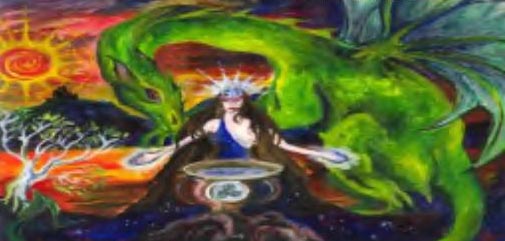
Ceriddwen is the Goddess of fertility and
inspiration. She created a cauldron of inspiration to give
her son Afagddu superior knowledge and wisdom. Ceriddwen's cauldron,
which has the power of initiation, came with
three muses, and helped her to be associated with the field of language,
poetry, and letters. She is often associated with
being a triple goddess (Boann and Brighid) and as the Lady of the
Lake.
Boann was an
Irish water and fertility goddess.
Special Birth: The birth of Aonghus
was no normal child's birth. Boann had the child
not by her husband but through her lover the Dagda. Neither wanted their
secret tryst to be known, and used their powers to alter the babies
womb time to 1 day instead of the
traditional 9 months.
Brighid is often
considered the triple goddess. History tells that the Dagda and Boann
had three daughters that were all named Brighid. This combination gives
her the traits of wisdom, divination,
fire, heath, poetry, prophecy, healing, smithing, and learning. She was
mostly associated with healing, fertility, and assisting women in labor.
Once Christianity took over the land, she become known at St. Brighid.
It was in the beginning of Arthur's time there lived in Penllyn a man named Tegid Voeland his wife Ceriddwen. There was born to him of his wife a son named Morvran ab Tegid, a daughter named Creirwy, and they had a brother, the most ill-favored man in the world, Avagddu. Ceriddwen, his mother, thought that he was not likely to be admitted among men of noble birth by reason of his ugliness, unless he had some exalted merits or knowledge. So she resolved according to the arts of the books of the Fferyllt, to boil a cauldron of Inspiration and Science for her son, that his reception might be honorable because of his knowledge of the mysteries of the future state of the world. Then she began to boil the cauldron, which might not cease to boil for a year and a day, until three blessed drops were obtained of the grace of Inspiration. And she put Gwion Bach the son of Gwreang of Llanfair in Caereinion, to stir the cauldron, and a blind man named Morda to kindle the fire beneath it. She charged them that they should not suffer it to cease boiling for the space of a year and a day. She, herself, according to the books of the astronomers, and in planetary hours, gathered every day of all charm-bearing herbs. One day, towards the end of the year, as Ceriddwen was culling plants and making incantations, it chanced that three drops of the charmed liquor flew out of the cauldron and fell upon the finger of Gwion Bach. By reason of their great heat he put his finger to his mouth, and the instant he put those drops into his mouth, he foresaw everything that was to come, and perceived that his chief care must be to guard against the wiles of Ceriddwen, for vast was her skill. In very great fear he fled towards his own land. The cauldron burst in two, because all the liquor within it except the three charm-bearing drops was poisonous. The horses of Gwyddon Garanhir were poisoned by the water of the stream into which the liquor of the cauldron ran, and the confluence of that stream was called the Poison of the Horses of Gwyddon from that time forth.
There upon came in Ceriddwen and saw all the toil of the whole year lost. She seized a billet of wood and struck the blind Morda on the head until one of his eyes fell out upon his cheek. He said, "Wrongfully hast thou disfigured me, for I am innocent. Thy loss was not because of me." "Thou speakest truth," said Ceriddwen, "it was Gwion Bach who robbed me." She went forth after him, running. He saw her and changed himself into a hare and fled. So she changed herself into a greyhound and turned him. He ran towards a river, and became a fish. She, in the form of an otter-bitch, chased him under the water, until he was fain to turn himself into a bird of the air. She, as a hawk, followed him and gave him no rest in the sky. Just as she was about to stoop upon him, and he was in fear of death, he spied a heap of winnowed wheat on the floor of a barn. He dropped among the wheat, and turned himself into one of the grains. Then she transformed herself into a high-crested black hen, and went to the wheat and scratched it with her feet, and found him out and swallowed him. As the story says, she bore him nine months, and when she was delivered of him, she could not find it in her heart to kill him, by reason of his beauty. So she wrapped him in a leather bag, and cast him into the sea to the mercy of God, on the twenty-ninth day of April. So, the great poet, Taliesin made an entrance into this world.
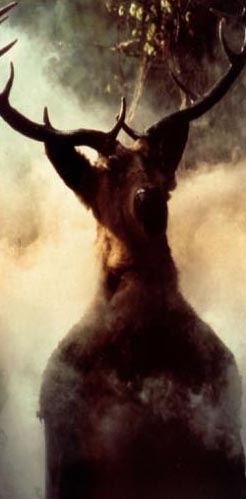
Of all
the old horned gods, none has such confused origins as Herne.
He
became a modern star in "Robin of Sherwood" on British
television in the early eighties, as the shamanic mentor of Robin
the Hooded Man, and this seems to be how everybody remembers him. In
the series he is portrayed as an Anglo-Saxon hunting god, but this
author can find no reference to such a god (even though there must have
been one).
It is interesting that several generations of consonantal
drift could very easily shorten Cernunnos to Cern, and then soften
it to Hern. It is therefore highly probable that these two horned gods
are related.
Whatever his lost origins as a deity, his origin
as a folk myth is much better known.
Sometime a keeper here in Windsor Forest,
Doth all the winter-time, at still midnight,
Walk round about an oak, with great ragged horns;
And there he blasts the tree, and takes the cattle,
And makes milch-kine yield blood, and shakes a chain
In a most hideous and dreadful manner.
You have heard of such a spirit, and well you know
The superstitious idle-headed eld
Received, and did deliver to our age,
This tale of Herne the Hunter for a truth.
Act 4 Scene 4
William Shakespeare
William finished his play in 1597, and for local colour added the above reference to what must have been a well known local legend. No earlier reference to Herne is known to exist, but many versions appeared later variously embellished. The most detailed (not necessarily the most authentic) was in W Harrison Ainsworth's novel "Windsor Castle", written in 1843, which went roughly as follows.
In the reign of King Richard II (1377-1399) there worked in the King's estate of Windsor Forest a particularly competent young keeper called Herne. Human nature being what it is, the other less competent keepers resented him somewhat. One day whilst out hunting the King was thrown from his horse and was about to be gored by a stag when Herne stabbed it in the throat, getting fatally gored himself. As he lay dying a mysterious stranger appeared calling himself Philip Urswick and offered to cure him, and the king agreed. Philip also secretly agreed with the other keepers that he would see to it that Herne lost all of his skill if they would agree to his next request.
Philip then cut off the stag's antlers and skull and tied them to the dying man's head, prescribing plenty of rest. The king rewarded him with silver and gold, and mysterious Phil returned home to Bagshot Heath.
Sure enough Herne recovered his health, although the antlers became permanent, but he also lost all of his marvelous skill. So the king sacked him. Bloody typical. Poor Herne rode off demented into Home park, and was last seen by a peddler later that same day hanging from an oak tree, but by the time he returned with the other keepers the body had mysteriously vanished. That night Herne's Oak was struck by lightning.
Now a curse seemed to fall upon the other keepers, rendering them even more incompetent than before. They consulted Urswick who told them to go to Herne's Oak at midnight, and when they did so Herne's ghost, complete with antlers, appeared to them, and ordered them to return the next night with horses and hounds, ready for the hunt.
The next night the keepers returned as ordered, but when Herne reappeared he promptly rode off through the forest, forcing the keepers to follow in pursuit. After a wild ride they suddenly stopped to find Urswick before them, and they owed him a favour. He commanded the (still living) keepers to ride with Herne's Wild Hunt forever.
And so they did, meeting every night at Herne's Oak before riding forth with the horned ghost, causing no end of trouble every night, killing deer, vandalising park benches, and generally being unpleasant. Finally the king had had enough, and went with them to confront the shade of his ex-employee. When challenged Herne said that he rode for vengeance, and promised to haunt no more during the king's reign on condition that he hung the other keepers from the very oak where he died. Needless to say, Dicky wasted little time on that executive decision, and they were all hanged the following day.
And so after King Richard II's abdication in 1399 Herne and his Wild Hunt rode forth down all the centuries, even down to our own, collecting the souls of the dead.
After "The Merry Wives of Windsor" became a smash hit Herne's Oak became a local tourist attraction, until in 1796 it was chopped down due to an administrative error. Its remains were turned into souvenirs (see right). Herne, however, continued to haunt the park as ever, and there were even stories of how, on a dark and stormy night, the ghost of the actual tree itself could be seen, haunting the spot where it was felled.
Other oaks were planted on various nearby sites, all suspected to be the original, and in 1906 King Edward VII planted the current one. Unfortunately it is difficult to visit because it is now inside the royal enclosure in The Home Park, just North of Frogmore.
One day two local Windsor youths and a Teddy boy were playing truant in Windsor Great Park. (Note: Teddy boys were a kind of delinquent British sub-culture in the fifties and sixties.) They were up to the usual no good, breaking trees and generally fooling around, the local youths being led on by the Ted.
The troublesome trio were in an area of forest when the Ted noticed a curious old hunting horn hanging from a tree, and immediately picked it up. The local youths, knowing something of the legend, told him to put it down and walk away, so as an act of bravado instead, he blew upon it. All three immediately heard the sound of baying hounds, and horses crashing through the trees, close by and getting closer.
The local boys threw themselves to the ground and covered their eyes, and told the Ted to do the same, as the sounds of the hunt drew ever nearer. In no time the deafening racket was all about them, and it was all they could do to stay still while the thud of horses hooves and snarls of great dogs were all about their heads. One of the youths sneaked a look at his companion, who's eyes were screwed tightly shut, then the Teddy boy, just in time to see him panic and turn to regard the source of the din all about them. The Ted's eyes widened in fear, and he began to scream, at which the other lad buried his face once again in the soil and prayed. He heard the sound of a single arrow being loosed and striking its target, and then the noise began to fade, until the forest was quiet once again.
When they finally got to their feet the forest was as quiet as before and the two lads were safe, but the Teddy boy had vanished, never to be seen again.
Europe abounds with stories of The Wild Hunt, and Herne is just one of the Wild Huntsmen. Others include Arawn the Welsh god of the dead, Charlemagne, Frederick the Great, King Arthur, the Saxon god Woden, the early British King Herla, The Devil, Sir Francis Drake, Father Christmas and Odin. The origins of the widespread legend of The Wild Hunt are so buried under centuries of mythic detritus that they will never be known.
What is known for certain is that a remarkably consistent image exists in the mythic subconscious of Europe: the image of the wild, nocturnal, horned huntsman, his coming announced by the baying of his hounds and the blast of his horn above the din of the storm, in search of souls to carry away.
Is this Herne ?
The Mask of Herne
Was Herne once a European hunting god who also carried souls to the underworld ? Or is he just a local ghost that haunts Windsor ? Here is another creepy story, but this time all the facts are a matter of public record.
In 1487 the last Keeper of Windsor Great Park (and therefore a successor of Herne himself), one William Evingdon donated a building to the parish of Windsor, "for the good of his soul". This property was opposite the parish church on Windsor High Street, and it became the vicarage. About 450 years later in the early 1930s the vicarage was moved to Park Street, and during the move workmen dug up a strange object.
It was a carved stone head of something not quite human. It had the face of a man, including a moustache, but the ears and antlers of a stag. The eyes were deep-set and fierce.
There were many theories as to its origin. It may have been part of a gargoyle or some other grotesque church ornament, and indeed it has been described as looking something like the carved stone Green Man faces which decorate many churches. Some suggested that it had last belonged to William Evingdon, and that it was passed on from Keeper to Keeper as some kind of tradition, or symbol of office. It became known as The Mask of Herne.
It first became the property of a Mr Bayley who owned it until the church claimed it back in the late thirties, when it was put in the garden of the new vicarage in Park Street. It seems to have been left there until after the 2nd World War when the vicarage was sold and the mask placed in the church museum, where it remained until 1963 when it was stolen.
In spite of its spell in a museum, the only image of this object that this author can find is the sketch to the left, made by Michael Bayley, the son of the man who owned it during the mid thirties. This is the sketch that Michael Bayley presented to Eric Fitch during his research (see further Reading, below).
So, come on, own up. If you are reading this page you are very likely the sort of person who would take an interest in an ancient horned god cult object, and it is just possible that you, yes YOU know where it is. If you do, you can tell me. I just want to see it, touch it and draw it. Pleeeeez ? I swear on God's Horns not to tell the Old Bill. The last place it belongs is in a Christian Church museum.
There is a creepy epilogue to this story.
One day in 1856 two young boys, William Fenwick and William Butterworth, were offered a lift by a stranger driving a horse and carriage. He took the two Williams to Albany Road, near Park Street, where they became drowsy and passed out for no apparent reason. They woke up several hours later in The Home Park itself by Victoria Bridge, and could not remember how they got there. The police became involved but nothing ever came of the investigation, and it was put down to an eccentric kidnapping or childish imagination. (Does this remind you at all of UFO abductions ?)
When the The Mask of Herne was dug up in the 1930s William Fenwick, now an old man, was shown a photograph of the stone head, and said that he was in no doubt that the face in the stone was the same face as the man who had kidnapped him and his friend nearly 80 years before. Presumably minus the horns.
Who is the Inner Goddess?
Every woman is Goddess! Our inner
consciousness connects with different goddess
attributes at different times at work or play, in the
mornings or evenings and through moon cycles. Each
Goddess brings her essential energy to energise us through each
stage. When we recognise and harness the Goddess
energy that is working within, we have successfully
reconnected with our own Inner Goddess.
In the beginning, women were acknowledged and revered as the spiritual keepers - pregnant women especially were enshrined, the gift of life being a sacred mystery. Every culture globally knew and accepted the loving rule of the Goddesses. Modern women are now "remembering" their rightful place in the world... you are here at this site after all!
Tips on how to be Goddess
Cultivate intuition
Glow with inner beauty and sensuality
Shine and
inspire
Share your knowledge
Radiate with
love and light
Raise as a Sun Goddess
Be
strong like the lioness
Radiate like fire
Hold your vision without reservation
Plan
step-by-step between here and its reality
Realise your dream,
revel in its manifestation
Information on Gods and Goddesses thanks to: http://www.lugodoc.demon.co.uk/HERNE.HTM - http://www.gods-heros-myth.com/godpages/ceridwen.html - http://www.missgien.net/arthurian/mabinogion/taliesin.html
Translate This Page
